
A vague brief, 25 minutes, a full campaign on brand
So I watched a marketer run a real campaign through Claude this week and it reset how I think about skills. One brief, almost no detail, and 25 minutes of compute later there's a deck, a set of carousels, an animated video, and a landing page. All on brand. All linked. Output looked like a junior team had spent a week on it.
The piece that mattered wasn't the volume. It was the structure underneath. Once you stop treating Claude as a chat box and start treating it as a stack of named skills, the leverage changes shape.
Three patterns from the walkthrough are worth stealing this week.

*Ad
A thousand AI startups just became obsolete.
Anthropic’s Managed Agents let you build and launch powerful AI agents: no backend, no infrastructure. From prototype to production in days, not months.
But the real question is how can you learn this?
Outskill can help you master AI in just 2 days - the skill that can make you smarter, faster, more revenue driven and absolutely irreplaceable in 2026.
In this 16-hour AI Mastermind, you’ll learn real AI use cases, automations, and workflows- turning AI into your edge for 2026.
The best part? They’re giving it away completely FREE for the next 48 hours!
🧠Live sessions- Saturday and Sunday
🕜10 AM EST to 7PM EST
🎁 You will also unlock $5000+ in AI resources: (as bonuses when you show up!)
- A Prompt Bible 📚,
- Roadmap to Monetize with AI 💰
- Personalised AI toolkit builder ⚙️
Register here for $0 (free for next 72 hours only)
Map your week into 3 skill buckets
The single most useful frame from the whole video: every Claude skill you'll ever build falls into one of three buckets.
Brand skills hold your standards. Voice, design system, the rules for what you'd never publish. Foundation layer, every other skill calls into it.
Function skills handle the work you actually do. Campaign planning, carousels, landing pages, video. The verbs of your week.
Specialty skills cover the rules specific to your industry. Healthcare disclaimers. Compliance language. Whatever your domain forces you to think about that nobody else does.
The action: list the 5 things you actually repeat every week, sort them into these buckets, and build the brand layer first. Everything else stacks on top.
In partnership with

How Jennifer Aniston’s LolaVie brand grew sales 40% with CTV ads

For its first CTV campaign, Jennifer Aniston’s DTC haircare brand LolaVie had a few non-negotiables. The campaign had to be simple. It had to demonstrate measurable impact. And it had to be full-funnel.
LolaVie used Roku Ads Manager to test and optimize creatives — reaching millions of potential customers at all stages of their purchase journeys. Roku Ads Manager helped the brand convey LolaVie’s playful voice while helping drive omnichannel sales across both ecommerce and retail touchpoints.
The campaign included an Action Ad overlay that let viewers shop directly from their TVs by clicking OK on their Roku remote. This guided them to the website to buy LolaVie products.
Discover how Roku Ads Manager helped LolaVie drive big sales and customer growth with self-serve TV ads.
The DTC beauty category is crowded. To break through, Jennifer Aniston’s brand LolaVie, worked with Roku Ads Manager to easily set up, test, and optimize CTV ad creatives. The campaign helped drive a big lift in sales and customer growth, helping LolaVie break through in the crowded beauty category.
The folder beats the prompt, again
The setup is the same one we've been pushing for months. One Claude code project. A context/ folder with brand context, ICP, and strategy. A campaigns/ folder for outputs. A CLAUDE.md that tells Claude how to navigate. Sound familiar? Same folder pattern, applied to a marketing team instead of a solo creator.
The new piece is the Claude design tool. It pulls colors, fonts, components, and logos from your existing assets and exports the design system as a portable skill you drop into any project. So the brand layer isn't a pile of PDFs anymore. It's a callable skill that every other skill can reference.
That's the unlock. Brand consistency stops being a manual review step and becomes a function call.
One agent that runs the whole stack
The orchestrator does the heavy lifting. The marketer gave the campaign manager agent almost nothing about a new product launch. The agent ran AskUserQuestion on her, pulled goal, budget, and audience, then dispatched the eight skills in sequence: research, deck, carousels, animated video, landing page, performance tracker with Excel formulas already baked in.
This is where the stack becomes a system. You stop calling skills one at a time and start calling the orchestrator. Sub-agents keep the main context clean, the task view shows you what's running, and you go from operator to project owner.
The catch: the agent command lives in Claude code terminal, not the desktop app. If you want orchestration, you need the CLI.
Demystify AI for Your Business in Just 4 Steps
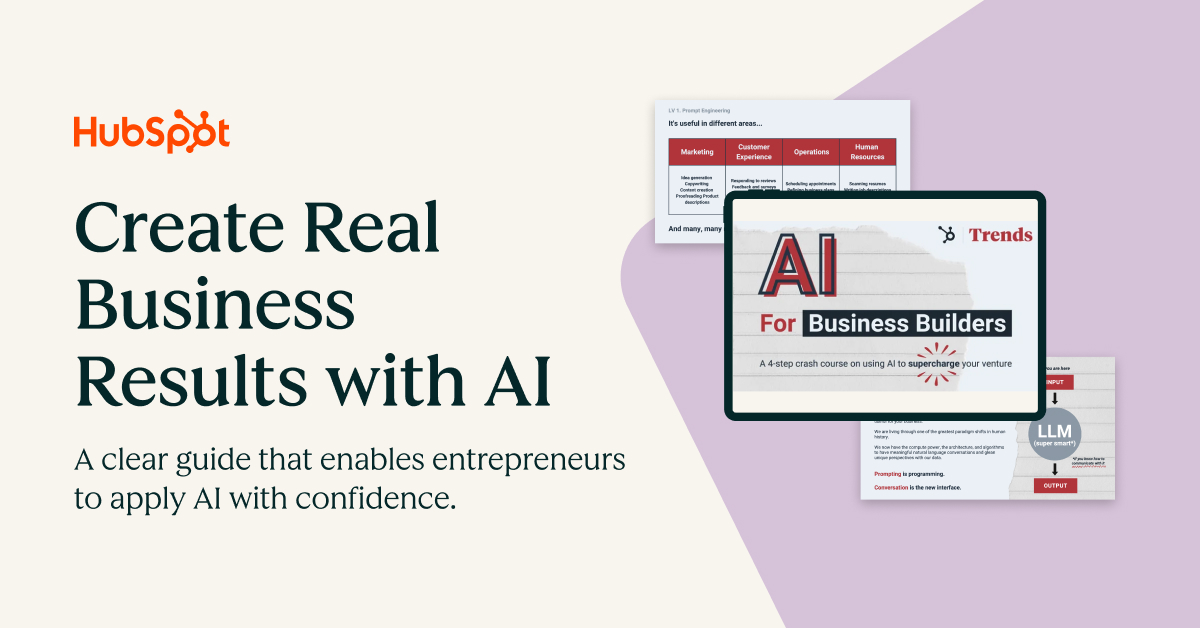
Overwhelmed by AI? HubSpot's free guide cuts through the noise. Get the ultimate crash course for non-technical entrepreneurs who want to harness AI's power—without getting lost in the jargon.
"AI for Business Builders" delivers:
• A 4-part roadmap to AI mastery
• Jargon-free explanations of large language models
• Practical prompt engineering tips you can use today
• Real-world examples of AI boosting businesses like yours
Arm yourself with the knowledge to make informed AI investments and skyrocket your startup's growth.
Download Your Free Guide Now
3 things to actually do this week
🔹 List your repeating tasks and bucket them. 10 minutes. Open a doc, write down the 5 marketing things you do every week, label each one Brand, Function, or Specialty. You now know which skill to build first.
🔹 Build the brand voice skill first. Pull your brand voice guide, drop in 3 examples of writing that's on, 3 examples of writing that's off, and add a one-line evaluation step at the end. Version it from day one. Every other skill leans on this one.
🔹 Try Claude design on one existing asset. Take a deck, a carousel, or a landing page you already shipped. Have Claude design extract the system. Export it as a skill. That's your design foundation built in under an hour.
The thing nobody's talking about
Versioning is the boring part that makes the whole system survive. Every skill ships into a Notion library with name, description, category, version, and the zipped file. A Claude routine scans for updates every Monday at 9 AM and auto-publishes them. No manual handoffs. No version drift. No three marketers running three different "brand voice" skills that all disagree.
This is the part that turns personal hack into team system. If you're solo, skip it. If anyone else touches the work, this is the difference between a stack that scales and a stack that fragments in 6 weeks.
One honest caveat. A couple of carousel slides in the demo had text overflow. The animated video reads as a landing page explainer, not broadcast quality. And Claude design generation runs 10 to 15 minutes per image, so you want your inputs locked before you hit go. Treat the eight-skill stack as a 90% solution that still needs an editor's eye on the way out.
Build it on one campaign this weekend
Don't try to clone the whole stack at once. Pick your next campaign. Build three skills only: brand voice, design system, and campaign planning. Run that mini-stack against a real brief. See how loaded the output comes back compared to your usual prompt-and-pray.
What you're looking for isn't speed. It's whether the first deliverable already feels on brand without you editing voice and design back in. If yes, the stack is working. Add the next skill. Then the next. The full eight-skill setup is the destination, not the starting line.
Full walkthrough with the eight skills broken down: cybercorsairs.com/claude-skills-stack
Worth the watch if you run any kind of recurring marketing work.
Poll: How did you like today's issue?
Hit reply and let us know why.

Payroll errors cost more than you think

While many businesses are solving problems at lightspeed, their payroll systems seem to stay stuck in the past. Deel's free Payroll Toolkit shows you what's actually changing in payroll this year, which problems hit first, and how to fix them before they cost you. Because new compliance rules, AI automation, and multi-country remote teams are all colliding at once.
Check out the free Deel Payroll Toolkit today and get a step-by-step roadmap to modernize operations, reduce manual work, and build a payroll strategy that scales with confidence.
*Ad