
Prompt engineering has a scaling problem
You write one great prompt. It works. Beautiful output, exactly the mood you wanted. Then you need ten more like it, slightly different. So you open the file, edit a line, break something, fix it, run again. Twenty minutes a variation. By the end of the week you've spent more time tweaking prompts than doing the work.
That's not a workflow. That's a treadmill. You're running to stay in the same place.
I had this problem for months on product shots. One prompt that nailed lighting. One that nailed mood. One that worked for hero crops. Three folders of nearly identical prompts, all slightly different, none of them scaling. Eventually you realize the prompt isn't the asset. The system that generates prompts is the asset.
100+ ChatGPT Prompts to Revolutionize Your Day
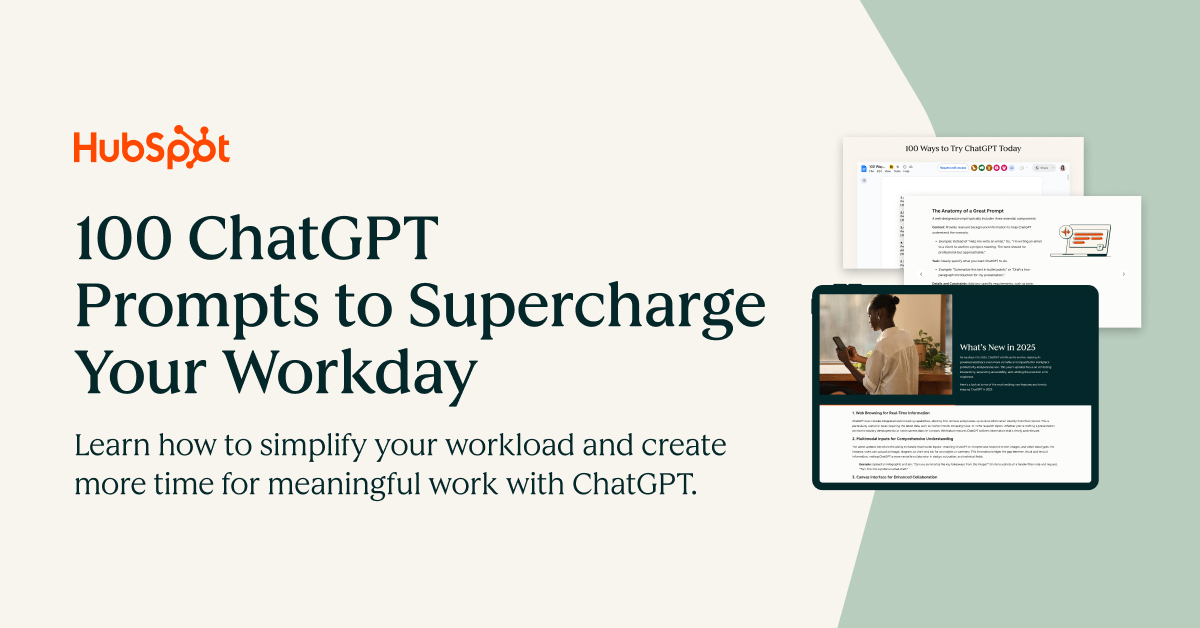
Supercharge your productivity with HubSpot's comprehensive guide. This free resource is your fast track to AI mastery:
• Industry-Specific Use Cases: 15+ real-world applications across various sectors
• Productivity Guide: 21 best practices to 10x your efficiency with AI
• Prompt Powerhouse: 100+ ready-to-use prompts for immediate implementation
• Challenge Buster: Overcome common AI hurdles with expert strategies
Plus, in-depth sections on email composition, content creation, customer support, and data analysis.
Find Your Guide Here
The flip: stop writing prompts, start teaching the model to write them
MetaPrompting reframes the whole job. Instead of crafting prompts directly, you write a meta-prompt that instructs the LLM how to generate them for you, with structured variety baked in. The model becomes the prompt engineer. You become the architect.
The technique was demonstrated by u/90hex on r/PromptEngineering for Z Image Turbo inside ComfyUI, but the concept generalizes. Anywhere you need structured variety at scale, the same pattern applies.
The shift sounds small. It isn't. You stop asking "what prompt gets me the output I want?" and start asking "what instructions teach the model to be my prompt engineer?" That's a different level of leverage entirely.
Option blocks are the mechanism that makes it work
The core trick is option blocks. Instead of one fixed prompt, the meta-prompt tells the model to output a structure with interchangeable components. Subject variations. Style modifiers. Environment options. Technical parameters. Each run picks fresh from the menu without you doing any work.
Think about what's actually happening. When you write a fixed prompt, you're making dozens of micro-decisions and locking them in. Lighting, mood, framing, angle. Option blocks distribute those decisions back to the model, but only inside ranges you've already approved. The model isn't guessing randomly. It's selecting from a pre-vetted set.
You get variation without chaos. Diversity without losing control. A well-built option block system pumps out a hundred meaningfully different outputs before you ever touch the meta-prompt again. That ratio is what makes the setup time worth it.
In partnership with

The CEOs of NVIDIA, Tesla, & Microsoft Agree on One Secret

This year, the world’s biggest tech CEOs all said the same thing:
NVIDIA’s Jensen Huang called robotics a “once-in-a-lifetime opportunity.”
Microsoft’s Satya Nadella said 2026 is when AI will deliver real impact.
Tesla’s Elon Musk predicted, “AI and robots will make everyone wealthy.”
That opportunity’s arrived. Miso Robotics is leading the charge in bringing robotics solutions to the $1T fast-food industry.
Miso’s Flippy Fry Station AI robot has already logged 200K+ hours for fast-food brands like White Castle. Now, Miso has added iconic restaurant brands like Jersey Mike’s, Jamba, and Cinnabon as new customers.
With a new NVIDIA collaboration, strategic investment by industry leader Ecolab, and a growing manufacturing partnership, Miso can now scale to meet 100,000+ US fast-food restaurant locations, a $4B/year revenue opportunity.
This is a paid advertisement for Miso Robotics’ Regulation A offering. Please read the offering circular at invest.misorobotics.com.
The description field is the activation gate
If your Skill barely activates, the description is almost always the culprit. The description is the field Claude scans to decide whether to load your Skill at all. A weak one means the Skill never gets a chance to run.
Five signals every description has to send. What the Skill does. When to use it. What user language should trigger it. What context matters. What output is expected. Hit all five and activation becomes almost automatic. Miss one and Claude is guessing.
"Helps with database stuff" never triggers. "Use when configuring database connection pooling, choosing pool sizes, or debugging connection exhaustion, output a config block plus a short rationale" triggers reliably. Specificity is what wins.
3 things to actually do this week
🔹 Audit one Skill against the 9-point anatomy. Clear name, clear description, clear use case, clear trigger phrases, clear output format, clear rules, clear examples, clear support files, clear execution boundaries. If any of those are fuzzy, fix them before you ship the next build. Fuzzy means failure later.
🔹 Move heavy content out of SKILL.md. Open your most-used Skill. Cut every example, template, and reference into separate files. Leave only the lean instructions and a pointer to where the supporting files live. Test activation again. The Skill should fire faster and follow instructions tighter.
🔹 Rewrite one description with all 5 signals. Pick the Skill that activates least reliably. Rewrite the description so it covers what it does, when to use it, trigger language, context, and expected output. Run your normal trigger phrases. Watch activation rate jump.
The thing nobody's saying out loud
Constraints beat completeness. Most Skill advice tells you to add more, more rules, more edge cases, more guidance. The Skills that actually work do the opposite. Narrow scope. Lean instructions. Support files. Safe execution. Clear triggers. Simple process. Real examples. Every bullet is a deliberate cut.
Precision beats volume on every dimension that matters. The builders shipping reliable Skills are not the ones writing the longest SKILL.md files. They are the ones holding the line on what doesn't belong inside.
Next time you're tempted to add another paragraph of rules to SKILL.md, ask whether it belongs in a support file instead. You won't go back to the brain-dump approach after that.
GTM Atlas, by Attio

GTM Atlas is a free resource every operator should read. Curated by Attio, the AI CRM, and written by GTM leaders from Lovable, Granola, and Vercel, you'll get:
ICP, outbound, and retention frameworks from operators who've built them
The qualification signals that actually predict conversion
Conversion plays that don't rely on a pitch deck
Mapped by operators. Curated by Attio.
*Ad
This isn't an image-gen trick, it's a leverage pattern
Image generation is just the most visible use case. The same logic applies to anything repetitive: content pipelines, code generation, data labeling, social post variations.
Picture a content team producing social posts at volume. Old way: a writer drafts five variations of the same hook by hand. New way: one meta-prompt generates twenty structured options in seconds, each hitting a different angle, tone, or framing. The writer's job shifts from production to curation. Same output quality, fraction of the time.
That shift, from production to curation, is the actual unlock. You stop being the person typing the prompt and start being the person who designs the system that types prompts. Different leverage. Different ceiling.
Where to start
The original u/90hex post on r/PromptEngineering includes a working sample for Z Image Turbo. Worth studying as a concrete starting point before building your own. The sample alone teaches the structure. Everything after that is adapting it to your use case.
Setup overhead is real but pays back fast. Most people who try this recoup the investment inside their first serious production run. After that it just keeps compounding.